
Critical Infrastructure4 min readNote
Space is critical infrastructure: what a webinar on national autonomy says to those who sign off on risk
I took part in the 6th Espaço em Pauta webinar, run by Brazil's Institutional Security Cabinet, on space as an element of national strategic autonomy, representing Telebras. The lens of the Brazilian Defense College helps explain why this is a matter for senior management, not only for engineering.
Originally published as a note on LinkedIn, in September 2026. This text develops that note.
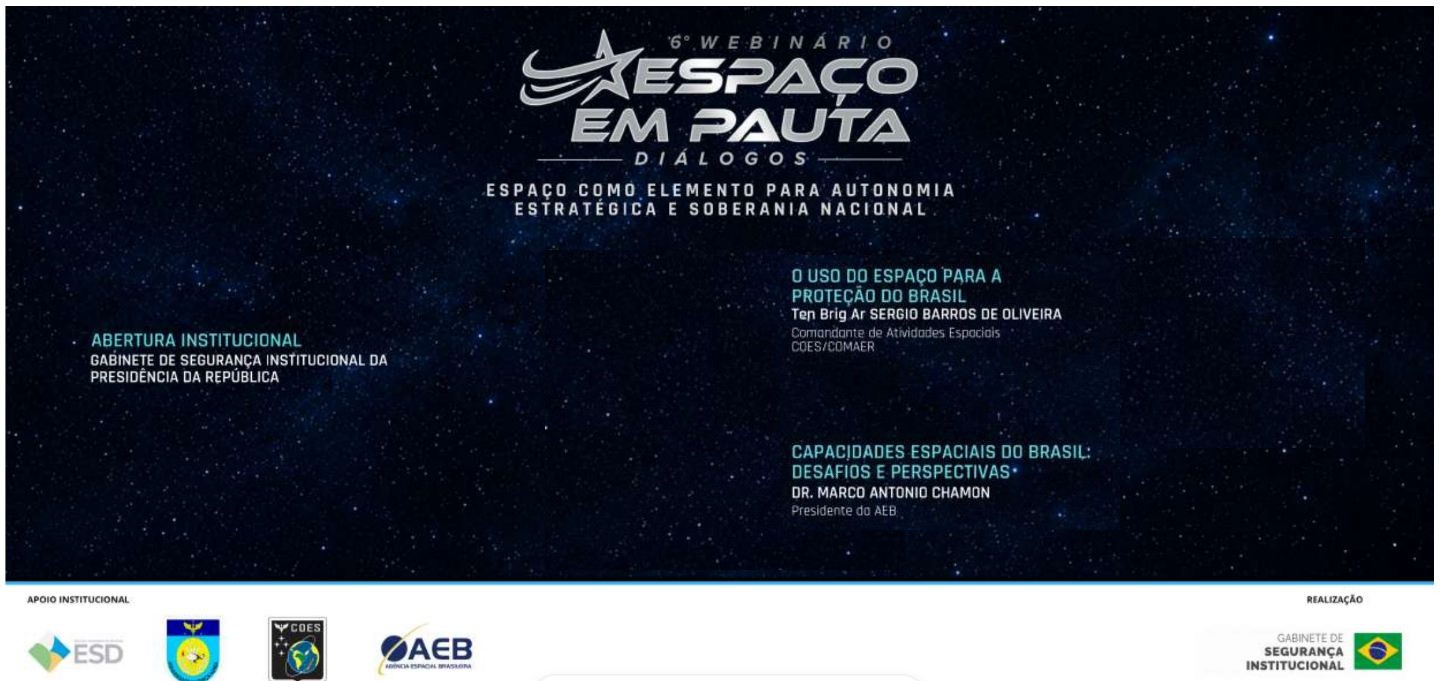
On 3 September 2026 I took part in the 6th Espaço em Pauta – Dialogues webinar, on the theme “Space as an Element for Strategic Autonomy and National Sovereignty”, run by the Institutional Security Cabinet of the Presidency of the Republic through its Secretariat for the Coordination of Space Affairs. I was there representing Telebras and as an alumnus of the Escola Superior de Defesa (ESD), the Brazilian Defense College, which supported the event institutionally.
Two talks structured the meeting: “The use of space for the protection of Brazil”, by Lieutenant Brigadier Sergio Barros de Oliveira, Commander of Space Activities of the Brazilian Air Force (COES/FAB), and “Brazil’s space capabilities: challenges and perspectives”, by Marco Antonio Chamon, president of the Brazilian Space Agency (AEB). The Espaço em Pauta series brings into the same room people who rarely sit together: the civil space agency, the military space command, the defense industrial base and the academic community. The stated objective is to strengthen the Brazilian Space Program and to treat the aerospace sector as what it is — a condition for the country’s technological autonomy.
This text is not a report on the webinar. It is the reading I made of it, and what that reading led me to write afterwards.
What the Brazilian Defense College adds to this reading
The ESD brings to this debate a lens the technical sector does not supply on its own. Its mission starts from the relationship between National Defense, Security and Development: it is not enough to ask how to protect a strategic capability, one has to understand how it sustains the functioning of the State, economic development and the country’s autonomy of decision. That perspective changes the conversation about space.
Satellites stop being technological assets or instruments of the armed forces and become part of the infrastructure on which communications, navigation, time synchronization, Earth observation, meteorology, border monitoring, financial operations, power grids and a growing share of the digital economy all rest. It is at that intersection that space stops being a matter confined to engineering and starts to concern senior management.
For anyone looking at the problem through the lens of Security, Development and Defense, the question is not only “do we have access to space?” It is also: which space capabilities does the country depend on, who controls them, what are the alternatives in case of unavailability, and how much of that dependency are we willing to accept.
This is a discussion about national autonomy and about risk management at the same time. A country that treats space as an element of its strategic autonomy needs organizations that recognize space capabilities as part of their own operational continuity, and the relationship runs both ways: national security depends on resilient infrastructure, and resilient critical infrastructure depends on national capabilities — or, at the very least, on external dependencies that are known, governed and substitutable.
That is the most useful contribution of the perspective taught at the Brazilian Defense College: Security, Development and Defense are not independent compartments. An apparently technical decision about telecommunications, power, positioning or synchronization is, ultimately, a decision about strategic autonomy. And the four questions above do not stop at the State: they come down into every organization that operates something essential.
My contribution
Two of those questions did not fit in a note. Each became a text.
Low, medium and geostationary orbit: what changed, and why GEO didn’t die takes up the first two — which capabilities the country depends on, and who controls them. If there are now more than eleven thousand satellites in low orbit and no region of the planet left without possible coverage, why does Brazil remain interested in a geostationary satellite of its own? The text separates the three altitudes by the problem each one solves, shows why an entirely terrestrial network still depends on space, and arrives at the point that matters to whoever decides: contracting orbital capacity is easy; what actually gets decided is where the point of control sits.
The time is Brazilian, the signal is foreign takes up the last two — what the alternatives are in case of unavailability, and how much dependency is acceptable. Brazil has its own legal time, backed by a 1913 statute and atomic clocks at the National Observatory, but the rules obliging the financial and power sectors to synchronize say nothing about where the signal must come from. In practice, it comes from constellations the country does not control. The text walks through what ONS, the CVM and B3 require, what recent interference has already demonstrated, and what other countries have done about it.
Both start from the same observation drawn from the webinar: dependence on space is not a subject for the future. It is a present condition, already written into sector regulation, and still little discussed at the tables where risk and opportunity are decided.
Opinions published here are my own and do not represent Telebras, CelgPar, Banese or any other organization I work or have worked for. Nothing here is investment advice.