
Critical Infrastructure4 min readExplainer
Tier IV: what it really means, and why it matters for critical infrastructure
Is a Tier IV data center just a data center with a lot of redundancy? No. And perhaps the best way to understand the difference is to start with energy.
Originally published on LinkedIn, in Portuguese, on September 5, 2026.
Is a Tier IV data center just a data center with a lot of redundancy?
No. And perhaps the best way to understand the difference is to start with energy.
Brazil has one of the largest interconnected power systems in the world. The National Interconnected System (SIN) links different generation sources and regions through an extensive transmission network, which even allows the country to take advantage of the energy complementarity between its regions.
But there is a fundamental difference between the security of the power system and the continuity of a critical digital load.
A large city can be served by an extremely robust power system and, even so, a critical infrastructure must be prepared for local disturbances, distribution failures, maintenance, weather events, power quality problems and other occurrences between the grid and the final load.
That is exactly where the architecture of a Tier IV data center sets itself apart.
The idea is not to depend on a single favorable condition in the external environment, but to build, internally, the capacity to keep operating in the face of failures. This requires an architecture designed end to end, with independent paths, physical segregation, on-site generation, redundant power and cooling systems, and the ability to keep operating under adverse conditions.
In other words, a Tier IV is not just a data center with more equipment. It is an infrastructure designed to keep working when part of it stops working.
And that level of resilience has to be present across the entire chain:
utility power → on-site generation → UPS → electrical distribution → cooling → automation → telecommunications → IT equipment.
It is precisely this fault-tolerance requirement, combined with greater complexity in design, operation and investment, that helps explain why Tier IV facilities are still relatively rare.
Tier III and Tier IV
This is also one of the main differences from Tier III.
A Tier III is concurrently maintainable: its architecture allows planned maintenance without interrupting operations.
A Tier IV adds a stronger requirement: fault tolerance. Beyond supporting maintenance without downtime, the infrastructure must withstand certain unplanned failures without the critical load being affected.
That level of protection has a cost. More equipment, more space, independent paths, physical segregation, generation, energy storage, continuous cooling, automation and far more sophisticated engineering.
That is why Tier IV is not necessarily “better” for every data center. It makes sense when the cost of unavailability is greater than the cost of building fault tolerance.
And perhaps that better explains its rarity.
A Brazilian Tier IV with a strategic mission
In the Uptime Institute’s public database, Brazil has few facilities certified Tier IV for both design and constructed facility. Among them is an infrastructure of particular relevance to the Brazilian public sector: the Main Space Operations Center, COPE-P, run jointly by Telebras and the Brazilian Air Force in Brasília.
COPE-P is part of the Brazilian Air Force’s Space Operations Command (COES/FAB), and its entire infrastructure was conceived to operate and monitor the Geostationary Defense and Strategic Communications Satellite, the SGDC. Functions directly related to strategic telecommunications, defense and public connectivity policy converge there.
The SGDC operates with two main missions:
- X band is dedicated to strategic defense communications.
- Ka band is used for public telecommunications and connectivity policy.
The ground infrastructure associated with the Space Operations Center takes part in the control, monitoring and operation of the satellite, including functions related to managing the space asset and the continuity of its services.
In that context, adopting a Tier IV infrastructure stops being merely a sophisticated technical choice. It becomes consistent with the criticality of the mission.
An outage, in this case, would not simply mean a website going down. We are talking about an infrastructure tied to strategic communications, defense, connectivity and the operation of a Brazilian space asset.
Two inseparable worlds
Having worked with both digital infrastructure and the power sector, I see these two worlds as increasingly inseparable.
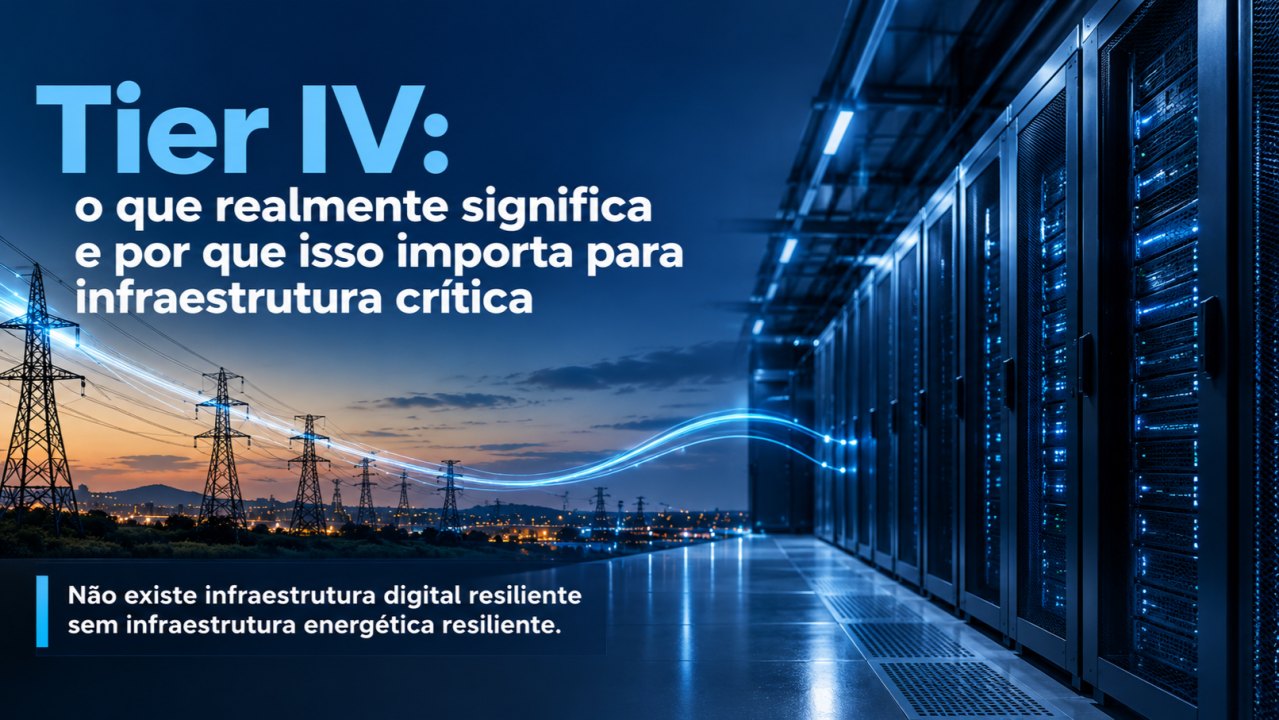
There is no resilient digital infrastructure without resilient energy infrastructure.
And when that infrastructure supports a country’s essential services and strategic assets, availability stops being just an IT metric. It becomes a matter of national resilience and digital sovereignty as well.
Opinions published here are my own and do not represent Telebras, CelgPar, Banese or any other organization I work or have worked for. Nothing here is investment advice.